

Category Type
Region/Country
Madagascar: Acute Food Insecurity Situation for March - May 2026 and Projections for June - September 2026 and October 2026 - February 2027
/sites/default/files/2026-07/IPC_Madagascar_AFI_AMN_Mar2026_Apr2027_Snapshot_English.pdf
Jul 15th, 2026
Acute food insecurity remains concerning in Madagascar—concentrated in the southern and eastern regions. Around 2.12 million people (7 percent of the analysed population) are classified in IPC Phase 3 or above (Crisis or worse) between June and September 2026, including over 183,000 people in IPC Phase 4 (Emergency) and 1.94 million people in IPC Phase 3 (Crisis). This is an overall decrease from 2.57 million people who faced Phase 3 or above between March and May 2026, as a result of partial post‑harvest improvements. The situation in the Grand South, however, is much worse than the previous period as the population experiencing Phase 4 rose sharply, from 25,000 people between March and May 2026 to 183,000 people in the June–September 2026 first projection period.
Madagascar: Acute Food Insecurity Situation for December 2025–January 2026 and Projection for February–April 2026
/sites/default/files/2026-01/IPC_Madagascar_Acute_Food_Insecurity_Dec2025_Apr2026_Snapshot.pdf
Jan 29th, 2026
Southern and eastern Madagascar continue to face persistently high levels of acute food insecurity (IPC Phase 3 or above), driven by a combination of factors, including significant climatic shocks and the impacts of the recent socio-political crisis, compounded by a reduction in humanitarian assistance.
In the current period (December 2025–January 2026), more than 1.57 million people are estimated to be experiencing high levels of acute food insecurity, including approximately 84,000 people in IPC Phase 4 (Emergency) and 1.49 million people in IPC Phase 3 (Crisis). This represents a deterioration compared to the situation originally projected in the July 2025 analysis. Populations in the greater south and greater southeast, as well as in the Atsimo Andrefana and Anosy regions, are particularly affected by these conditions.
For the projection period (February–April 2026), the overall trend points towards a further deterioration of the food security situation, with an estimated 1.8 million people likely to face high levels of acute food insecurity (IPC Phase 3 or above). This includes nearly 71,000 people expected to be in IPC Phase 4 and 1.73 million people projected to be in IPC Phase 3. This deterioration is in line with projections for the greater southeast area, where all analysed districts are expected to remain in Phase 3, driven by the combined effects of cyclone and flood risks, access constraints, and sustained health pressures. The most affected districts are projected to include Amboasary Atsimo (Anosy), Ampanihy (Atsimo Andrefana), and Mahanoro, Vatomandry and Maroantsetra.
In the current period (December 2025–January 2026), more than 1.57 million people are estimated to be experiencing high levels of acute food insecurity, including approximately 84,000 people in IPC Phase 4 (Emergency) and 1.49 million people in IPC Phase 3 (Crisis). This represents a deterioration compared to the situation originally projected in the July 2025 analysis. Populations in the greater south and greater southeast, as well as in the Atsimo Andrefana and Anosy regions, are particularly affected by these conditions.
For the projection period (February–April 2026), the overall trend points towards a further deterioration of the food security situation, with an estimated 1.8 million people likely to face high levels of acute food insecurity (IPC Phase 3 or above). This includes nearly 71,000 people expected to be in IPC Phase 4 and 1.73 million people projected to be in IPC Phase 3. This deterioration is in line with projections for the greater southeast area, where all analysed districts are expected to remain in Phase 3, driven by the combined effects of cyclone and flood risks, access constraints, and sustained health pressures. The most affected districts are projected to include Amboasary Atsimo (Anosy), Ampanihy (Atsimo Andrefana), and Mahanoro, Vatomandry and Maroantsetra.
Madagascar: Acute Malnutrition Situation for May - September 2025 and Projections for October 2025 - January 2026 and February - April 2026
/sites/default/files/2025-09/IPC_Madagascar_Acute_Food_Insecurity_Malnutrition_May2025_Apr2026_Snapshot_English_0.pdf
Sep 9th, 2025
Between May 2025 and April 2026, the acute malnutrition situation in Grand Sud and Ikongo (located in the Fitovinany Region of Grand Sud-Est) is projected to worsen significantly. An estimated 558,000 children under five are either currently suffering or at risk of suffering from acute malnutrition. Of these, approximately 155,600 are expected to face Severe Acute Malnutrition (SAM), while 402,400 are likely to experience Moderate Acute Malnutrition (MAM). In addition, around 38,500 pregnant and breastfeeding women (PBW) are expected to be affected during the same period.
Amboasary and Ikongo districts are already classified as IPC AMN Phase 3 (Severe) between May and September 2025. This severity is expected to intensify, with five additional districts projected to enter Phase 3 between October 2025 and January 2026. Notably, Ikongo could escalate to IPC AMN Phase 4 (Critical) during this period. By February to April 2026, Amboasary is also projected to reach Phase 4. The residual effects of harvests may temporarily obscure the full extent of the crisis between May and September, but underlying vulnerabilities persist.
Key drivers of acute malnutrition include very low food consumption, soaring food prices, limited market access, high child morbidity (notably from diarrhea and malaria), inadequate healthcare practices, and a fragile health system. These factors are compounded by climatic and socioeconomic shocks, deepening household vulnerability. Without urgent intervention, child survival is at serious risk across several districts.
Amboasary and Ikongo districts are already classified as IPC AMN Phase 3 (Severe) between May and September 2025. This severity is expected to intensify, with five additional districts projected to enter Phase 3 between October 2025 and January 2026. Notably, Ikongo could escalate to IPC AMN Phase 4 (Critical) during this period. By February to April 2026, Amboasary is also projected to reach Phase 4. The residual effects of harvests may temporarily obscure the full extent of the crisis between May and September, but underlying vulnerabilities persist.
Key drivers of acute malnutrition include very low food consumption, soaring food prices, limited market access, high child morbidity (notably from diarrhea and malaria), inadequate healthcare practices, and a fragile health system. These factors are compounded by climatic and socioeconomic shocks, deepening household vulnerability. Without urgent intervention, child survival is at serious risk across several districts.
FEWS NET Madagascar Food Security Alert - June 2021
https://fews.net/southern-africa/madagascar/alert/june-10-2021
Jun 10th, 2021
Significant scale-up needed in southern Madagascar to meet large-scale needs through early 2022
Global Food Assistance Outlook Brief Released
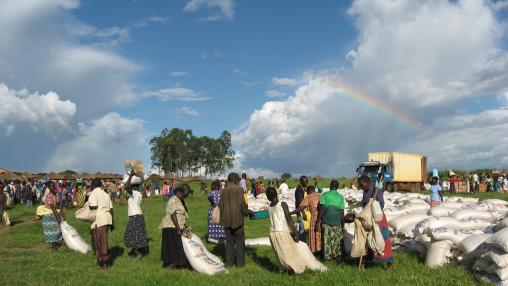
FEWS Net has released the latest Global Food Assistance Outlook Brief , covering projected food needs for November 2016. The report covers forward-looking analysis of projected emergency food needs in covered countries, based on the size of each country's acutely food insecure population and projected length of the lean season.