



Liens externes
The Food Security Portal gratefully acknowledges the European Commission (EC) and the Foreign, Commonwealth & Development Office (FCDO) of the Government of the United Kingdom for their financial support of the Ukraine crisis monitoring.
Last update: October 02, 2026
The crisis in Ukraine threatens global food security at a time when global food markets are already struggling with soaring prices, supply-chain disruptions, and a bumpy recovery from the pandemic. Ukraine and the Russian Federation account for more than 30% of global wheat exports, provide around 12 percent of the globally traded supply of food energy in kilo calories, and are breadbaskets to many food import-dependent developing countries in the Middle East, South Asia, and sub-Saharan Africa. Moreover, Russia is a major producer of fertilizer. Any serious disruption of production and exports from these suppliers will drive up prices further and erode food security for millions of people. If governments respond with export restrictions in an effort to keep domestic food prices in check, the impact on food security will be even higher.
In this context, monitoring the impact of the crisis on food security is key. To that end, this page provides several tools to monitor the situation. Here you can monitor production and stocks, track food export restrictions, check food price volatility, and access resources such as the AMIS Market Monitor.
The AMIS Market Monitor October 2026
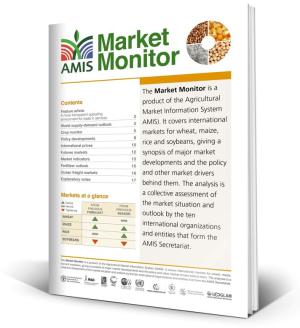
International prices in September remained above year-earlier levels. Wheat prices rose sharply early in the month amid disruptions to Black Sea exports, but retreated towards month-end as expectations of improved trade flows eased market concerns. Weather concerns, shifting production prospects and solid demand continued to underpin market sentiment across major crops. Global supply prospects remain generally favourable, although production forecasts for maize and soybeans were revised lower this month. As highlighted in this issue’s feature article, the strengthening El Niño is adding a new layer of uncertainty to production prospects, particularly for rice in South and Southeast Asia. At the same time, elevated freight rates, firmer fertilizer markets and continued logistical disruptions are contributing to a more uncertain market environment.
Vulnerability to Global Market Shocks V.2: Price Shocks to Major Staple Foods
Vulnerability to Global Market Shocks V.1: Wheat and Fertilizer Price Shocks Caused by Ukraine Crisis
This tool is designed to identify the exposure (vulnerability) of countries to shocks in global markets that may cause supply shortages or price surges in staple foods and key agricultural inputs (like fertilizers) which could erode food security in countries if they are highly dependent on imports of such commodities and/or lack the economic capacity to cushion their vulnerable population against the impacts of those shocks.
Food and Fertilizer Export Restrictions Tracker
This unmaintained legacy tool is no longer updated, serving strictly as a historical reference for past food security in Asia.
Fertilizer Market Dashboard
The dashboard tracks global fertilizer market trends, price drivers, trade, and production, helping users monitor risks and understand impacts on food systems.
Production and Stocks Monitoring System
The dashboard tracks stock-to-use ratios, highlighting market tightness and vulnerability to shocks by comparing current stock levels with historical averages.
Excessive Food Price Volatility Early Warning System
The system monitors excessive volatility in food and fertilizer prices, identifying abnormal fluctuations to provide early warnings that support timely food-security responses.